India’s journey toward electric mobility represents a bold case study as to how the world’s most populous nation can modernize its fleet while tackling some of its most pressing environmental and economic challenges.
As air quality concerns continue to grow in urban centers and the need to reduce dependency on imported oil remains prominent, India has emerged as a leader in electric vehicle (EV) adoption. The country’s commitment to electrification reflects their ambitious goals, including positioning India as a global manufacturing leader in the EV space, all while meeting the diverse transportation needs of over 1.4 billion people.
A complex web of transportation needs
India’s transportation ecosystem is uniquely complex, shaped by economic diversity and varying geographic challenges. The country’s roads carry everything from two-wheelers navigating narrow lanes to heavy-duty trucks traveling vast distances between industrial centers. This decentralized, multimodal network includes passenger cars, 2-wheelers (2Ws) and 3-wheelers (3Ws), light, medium and heavy-duty commercial vehicles, and an extensive bus network.
The challenges of electrifying such a diverse fleet are vast, but India’s comprehensive and growing policy approaches demonstrate a nuanced understanding of each segment’s unique requirements. The country’s signature to the ZEV Declaration also signals its desire to lead by example in the global transition to zero-emission transportation.
Electrifying the passenger car
The electric passenger car segment in India has experienced rapid growth over the past few years. Last year’s impressive 20% year-on-year growth in battery electric vehicle sales for cars and vans brought nearly 100,000 electric vehicles on to Indian roads in 2024—a significant milestone that demonstrates growing consumer confidence.
The launch of the “Scheme to Promote Manufacturing of Electric Passenger Cars in India” this year represents another significant boost for electric car availability. The program will allow global EV manufacturers to import fully built electric cars at reduced import duty rates, so long as they commit to a minimum investment of USD $500 million in domestic manufacturing. This will not only inject a higher volume of electric cars into the market in the short term, but enable India to become a global manufacturing hub for electric cars over the long term, a major step towards meeting its targets.
Leading the world in two- and three-wheelers
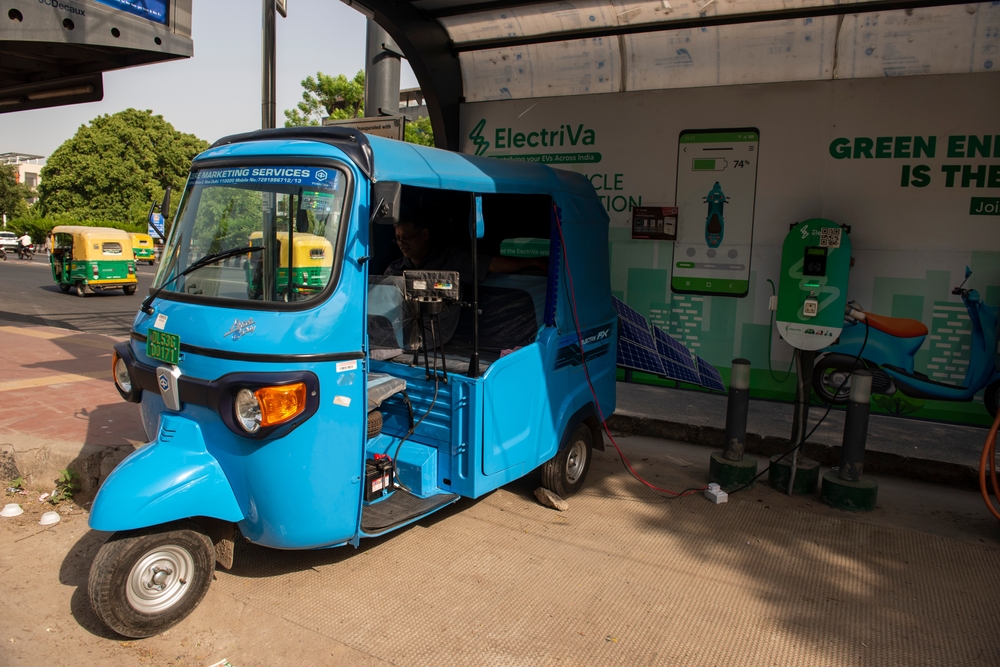
India’s EV success is most evident across the two- and three-wheeler segments. Their dominance in the electric 3W market is particularly striking—the country showed an impressive 57% sales share in 2024, making it the global leader in the segment. The electric 2W market is also showing promise, with a 6% sales share, establishing India as one of the largest markets outside of China.
This successful uptake is due in large part to purchase incentives, which have worked to achieve price parity between electric and internal combustion engine models—a crucial factor for many consumers when making purchasing decisions. These incentives, provided under the Phase I and II of the Faster Adoption and Manufacturing of (Hybrid &) Electric Vehicles (FAME) Scheme between 2015 and 2024, were recently expanded upon under the PM E-Drive Scheme launched last year. The scheme aims to further incentivize the sale of around 2.5 million electric 2Ws and 320,000 electric 3Ws through subsidies estimated at USD $315 million.
Medium and heavy-duty vehicles offer the greatest potential savings
Emissions from medium and heavy-duty vehicles and buses across India are currently estimated to account for roughly 50% of all road transport emissions, and without further action, this trend could continue upwards. Knowing this is a major challenge, a recent report from NITI Aayog, the government agency responsible for policy development, has identified buses and highway trucks as two “very high” priority segments for electrification.
The July 2025 draft fuel economy norms for medium and heavy-duty vehicles, currently under consultation, propose an ambitious 30% fuel consumption reduction target that would effectively accelerate the transition to zero-emission trucking between 2027-2032. The inclusion of super credits for zero-emission trucks demonstrates the government’s willingness to use regulatory tools creatively to drive market transformation.
For public transportation, the PM e-Bus Sewa-Payment Security Mechanism (PSM) Scheme launched in 2024 addresses the financial risk for operators when transitioning to electric. With a budget of approximately USD $400 million, the scheme provides payment security to e-bus operators in case of defaults by Public Transport Authorities, supporting the deployment of 38,000 electric buses across the country.
Lessons for a global transition
India’s multifaceted approach to electric vehicle adoption offers valuable insights for other emerging economies with similar challenges. The successes thus far stem from the recognition that different vehicle segments require tailored solutions—from achieving price parity to the development of public and private charging infrastructure, to scaling up domestic manufacturing. India’s progress to date shows that even the most complex transportation system can begin their transformation toward electrification.